Flat Drop Cable
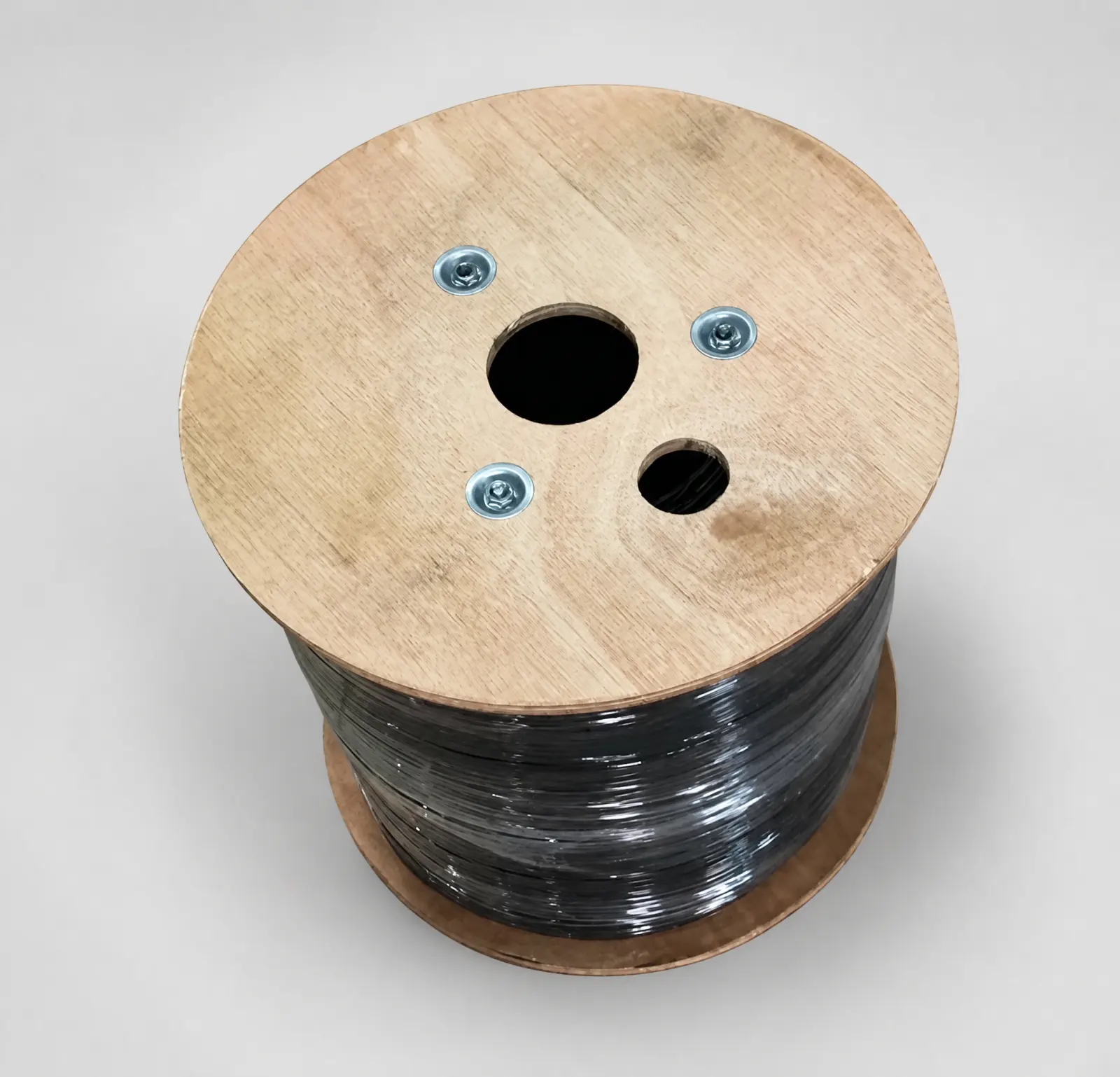
Flat Drop Cable
Overview Flat drop cable is the last-mile fibre cable. It runs from the distribution point or access terminal to the subscriber’s premises, and it is the cable an installer handles most often. It is a flat, compact construction with two parallel strength members running down each side and the optical fibre held between them. The flat profile is the point: thin enough to run along a wall, behind a panel or through a tight conduit, with the strength members on both sides of the fibre rather than wrapped around it — so the cable resists crushing and pulling without becoming bulky. Bend-insensitive fibre lets it turn the tight corners that real subscriber routes have, and the dry construction means there is no gel to clean out at the splice point.
Product Description
Page metadata
|
Field |
Content |
|
Page title |
Flat Drop Cable | FTTH Flat Drop & Toneable Drop Cable | [BRAND] |
|
Meta description |
Flat drop cable for FTTH last-mile runs. Bend-insensitive fibre, two parallel strength members and a dry construction. Standard, figure-8, toneable and pre-terminated versions. Made in our own factory. |
|
H1 |
Flat Drop Cable |
|
URL |
/flat-drop-cable/ |
|
Also known as |
Flat drop cable, FTTH flat drop cable, butterfly drop cable, flat fibre drop cable, indoor drop cable, toneable flat drop cable |
|
Parent page |
Fiber Optic Cable |
Key Features
Flat, compact profile — routes along walls, behind panels and through tight conduit
Two parallel strength members protect the fibre against crush and pull
Bend-insensitive fibre for the tight corners that real subscriber routes have
Dry construction — no gel or filling compound to clean out at the splice point
LSZH jacket — low smoke, halogen-free
Supplied in standard, figure-8 self-supporting, toneable and pre-terminated versions
Cable Variants
|
Variant |
Construction |
Where it is used |
|
Standard flat drop |
Two parallel strength members, fibre in the centre |
Wall-mounted runs, indoor routing, short aerial spans |
|
Figure-8 self-supporting |
Flat drop plus a steel messenger in one jacket |
Aerial spans — no separate support wire needed |
|
Toneable flat drop |
Flat drop plus a metallic tone wire |
Buried and ducted drops that must be located later |
|
Pre-terminated flat drop |
Any of the above with factory-fitted connectors |
Plug-and-play subscriber connections |
Confirm which of these variants we actually produce before publishing. See Values to Confirm.
Technical Specifications
|
Property |
Specification |
|
Construction |
Flat drop cable with two parallel strength members, fibre held in the centre |
|
Fiber count |
[TBC] — 1 / 2 / 4 is the common range |
|
Fiber type |
[TBC] — G.657.A1 or G.657.A2 bend-insensitive |
|
Strength member |
[TBC] — FRP (all-dielectric) or steel wire |
|
Outer jacket |
[TBC] — LSZH / PVC |
|
Jacket colour |
[TBC] — black (outdoor) / white (indoor) |
|
Cable dimensions |
[TBC] — common: 2.0 × 3.0 mm (1–2F), 2.0 × 4.0 mm (4F) |
|
Cable weight |
[TBC] |
|
Tensile load, short term |
[TBC] |
|
Tensile load, long term |
[TBC] |
|
Crush resistance |
[TBC] |
|
Min. bend radius, static |
[TBC] |
|
Min. bend radius, dynamic |
[TBC] |
|
Operating temperature |
[TBC] |
|
Attenuation |
[TBC] — single-mode reference: ≤0.36 dB/km at 1310 nm, ≤0.22 dB/km at 1550 nm |
|
Standard |
[TBC] — commonly cited: ITU-T G.657, IEC 60794 |
|
Drum length |
[TBC] — 2,000 m is the common standard |
|
Origin |
Manufactured in our own factory |
Applications
FTTH drop from the access terminal to the subscriber premises
Indoor routing in apartment blocks and multi-dwelling units
Aerial last spans, using the figure-8 version
Buried and ducted drops, using the toneable version
Wall-mounted and façade runs
How to Select
Confirm the route first. Indoor, aerial, buried or ducted — the route decides the cable variant before anything else is chosen.
Match the variant to the route. Aerial spans need the figure-8 version; buried or ducted routes need the toneable version if the cable has to be located later.
Confirm the fibre count and type. One or two fibres is normal for a drop; higher counts are used in multi-dwelling units. Confirm bend-insensitive fibre for tight bends.
Check the mechanical figures against the pull. Tensile load and minimum bend radius have to suit how the cable will actually be installed, not just the datasheet.
Confirm termination. Factory-fitted connectors save time on site; bare ends suit field splicing.
Frequently Asked Questions
Flat drop cable or round drop cable?
Flat drop is thinner and easier to route along surfaces, which makes it the usual choice for the subscriber drop. Round drop cable bends more freely and is often used for riser and conduit work.
What does “toneable” mean?
A metallic tone wire runs inside the cable, so the route can be found with a tone generator and probe. It is what makes a buried or ducted drop findable later — the same idea as detectable pull tape, applied to the drop cable itself.
Why use bend-insensitive fibre?
Subscriber routes have tight corners, and a conventional fibre loses signal when it is bent sharply. G.657.A1 or A2 tolerates a much smaller bend radius, which is what makes the compact flat design workable at the premises end.
Is it all-dielectric?
The FRP version is — it contains no metal. The figure-8 version contains a steel messenger, so check whether your route requires electrical isolation before specifying it.
Can it be installed in the same duct as other services?
That depends on local rules and on whether the cable is all-dielectric. Tell us the route and the services already in it and we will confirm.
Values to Confirm Before Publishing
Every [TBC] is specific to our own production. These are not industry standards and must not be filled with competitor figures.
Fiber counts available, and the standard and bend-insensitive fibre types offered
Strength member options — FRP only, steel only, or both
Whether a toneable version is available, and whether it is offered in every width and fibre count
Cable dimensions and weight for each fibre count
Tensile load (short and long term), crush resistance and bend radius
Operating temperature range
Jacket material and colour options
Attenuation figures, and which standards the cable is tested to
Drum length, drum type and marking on the drum
Notes for the Web Build
H2 structure: Overview · Key Features · Cable Variants · Technical Specifications · Applications · How to Select · FAQ · Request a Quote
Keyword targets: flat drop cable · FTTH flat drop cable · toneable flat drop cable · figure-8 drop cable · indoor fibre drop cable
Internal links: link up to Fiber Optic Cable, and across to Detectable Pull Tape (the toneable variant is the same locating idea) and to FTTH accessories.
Images: cable cross-section showing the two strength members either side of the fibre; a coil showing the flat profile; the cable routed along a wall; the toneable version with the tone wire visible.